24kt = 100% gold
22kt = 91.7% gold
18kt = 75% gold
14kt = 58.35% gold
12kt = 50% gold
10kt = 41.7% gold
In the UK, we mainly use 9kt and 18kt gold as it is important for gold, when being used for
diamond jewellery, to be combined with other alloys to strengthen it - see further information on this below.
PLATINUM
At 95% pure, platinum is the purest of all the precious metals - this is why it is sometimes referred to as 950 platinum. This purity provides a stunning metallic finish to
diamond engagement rings, for example, as it is perfect for maximising the brilliance of the diamond itself.
Platinum is rare, and is 30 times rarer than gold. In fact, it is estimated that if all the platinum in the world were poured into a single Olympic sized swimming pool, it would scarcely be deep enough to cover your ankles!
So, why is platinum so popular? The key to this lies in platinum's density and weight, which makes it much more durable than other jewellery metals. As a result, firstly, it provides the most secure setting for the diamond in
diamond engagement rings. Like all precious metals, platinum scratches. However, the scratch on an item of platinum
diamond jewellery is merely a displacement of the metal and none of its volume is lost. Finally, platinum's purity makes it hypoallergenic and ideal for those with sensitive skin.
WHITE GOLD & YELLOW GOLD
At
www.dejoria.co.uk, we only use the 18kt versions of these metals. Gold itself is a metallic element. In its pure form, it is too soft to be used for making
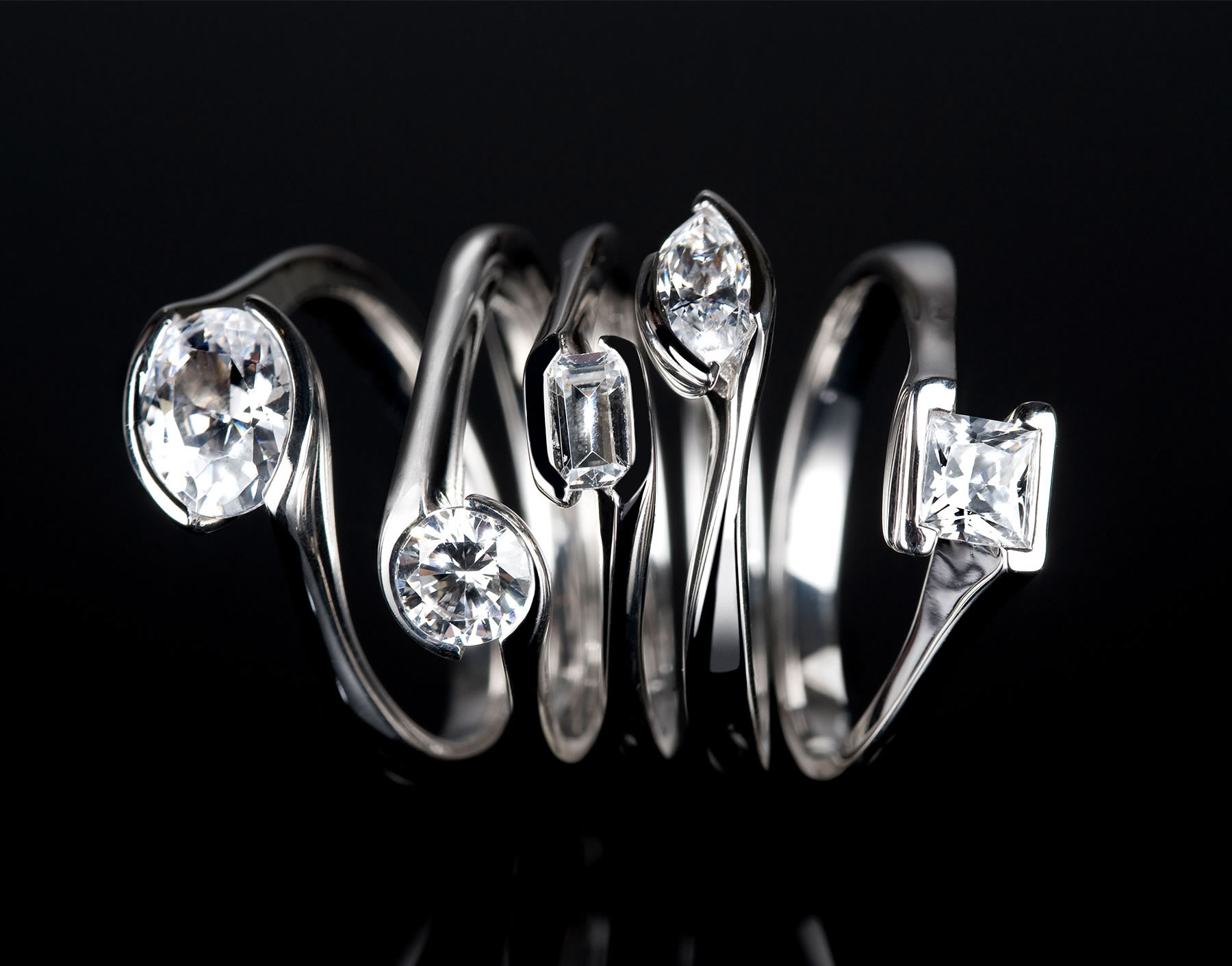
diamond jewellery. As a result, white gold is actually 75% gold mixed with other alloys to provide it with the required strength. Whilst white and yellow gold do provide secure settings for diamonds in
diamond engagement rings and other items of
diamond jewellery, they are not as secure as platinum.
When a piece of white gold
diamond jewellery has been produced, it is plated in rhodium which provides the item with its shiny finish. Over time, however, especially for items which are worn on a daily basis such as
diamond engagement rings or
diamond eternity rings, for example, the rhodium can tarnish and so white gold
diamond jewellery may need re-polishing every 18 months or so.
It is also possible to produce 'rose' gold which, again, is gold mixed with other metals - most notably copper in this instance - to provide it with a reddish-tint finish. At
www.dejoria.co.uk, we can also produce our
diamond engagement rings in rose gold if required.
HALLMARKING
Gold, silver and platinum are used as an alloy in the manufacture of precious metal jewellery. The precious metal is mixed with other elements to give it the properties, such as flexibility and durability, needed to produce a desirable article. Even the most experienced jeweller or chemist cannot tell, just by looking at the item of
diamond jewellery, how much precious metal there is in the alloy or whether a thick plating of precious metal is making a base metal core. This offers the unscrupulous a huge opportunity for fraud and there is a need to protect the public from those who may try to cheat them.
Therefore, it is a legal requirement in the UK (but not so the case in other countries) for all items of precious metal jewellery to be 'hallmarked', whether it be
diamond engagement rings,
diamond eternity rings,
diamond earrings,
diamond bracelets,
diamond pendants or
diamond necklaces, to conform with the legal standards of the Hallmarking Act, 1973.
In the UK, hallmarking a long history, dating back nearly 700 years, and representing the earliest form of consumer protection. The consumer benefits in many ways.
Hallmarks are small markings stamped on gold, silver and platinum items. A hallmark means that the article has been independently tested and guarantees that it conforms to all legal standards of purity (fineness). These tests are carried out only by an Assay Office, of which there are four in the UK - London, Birmingham, Sheffield and Edinburgh.
The Hallmarking Act 1973 changed on January 1 1999 and allows articles of higher and lower standards of fineness to be sold. This brings UK law into line with European law. Consumers may now choose from a much wider range of goods but continue to benefit from the same level of protection.
_small.jpg)
It is illegal for any trader to sell or describe a precious metal article as gold, silver or platinum unless it is hallmarked. Gold articles weighing less than 1 gram, silver articles weighing less than 7.78 grams and platinum articles weighing less than half a gram and exempt from hallmarking.
THE HALLMARKING PROCESS
Before any article can be hallmarked, it has to be assayed - ie tested - to check how much precious metal the item contains. To do this, minute laboratory-sized samples are scraped from the items and are then weighed accurately.
A 'fire refining' process, which selectively removes all the other elements in the sample, is used to assay gold.
In the case of silver, a process called 'potentiometric titration' is used to determine the silver content of the sample in parts per thousand.
Platinum, which was brought under hallmarking regulations in 1973, is assayed by a process called 'inductively coupled plasma-optical emission spectrophotometry'.
The results of these test determine the standard of purity mark applied to the items.
HISTORY OF HALLMARKING In 1238, Henry III commanded the Mayor of London to appoint six faithful and discreet goldsmiths who would be responsible for ensuring standards for gold and silver article.s Later, Edward I passed a statute requiring not only that all silver articles were to be of sterling standard, the same as coinage, but also they they were to be assayed by the Wardens of the Goldsmiths' Guild and marked with a leopard's head.
In 1327, the Goldsmiths' Guild recieved its first Royal Charter from Edwards III which confirmed its responsibility for assaying and marking. The Worhipful Company of Goldsmiths, as the guild was later called, is still responsible for the London Assay Office.
Under another statute in 1363, makers were ordered to stamp their own distinguishing marks alongside the leopard's head. Originally, the maker's mark took the form of a device, such as a cross or a fish; later, it became the practice to use the initials of the worker or firm.
In December 1478, the company appointed a salaried Assayer and compelled makers to bring their completed silverwares to Goldsmiths' Hall to be assayed and marked before they were offered for sale. This practice has continued to the present day and is the origin of the word 'hallmark'. In the same year, an additional mark - the date letter - was introduced by the company. This consisted of a letter of the alphabet which was changed anually. When one alphabet cycle was completed, the style of the letter or its surrounding shield was altered.
Hallmarking continued during succeeding centuries at Goldsmiths' Hall and at the Assay Offices, which later opened in other towns, such as Newcastle, Exeter and York, where there were working goldsmiths and silversmiths. In Scotland, there were goldsmiths working at a date as early as in England. The earliest records pertain to the goldsmiths of Edinburgh. An Act of Parliament was passed in 1773 establishing Assay Offices in Birmingham and Sheffield.
Several of the provincial offices have now closed - Newcastle, Exeter and York in the 19th century, Chester in 1962 and Glasgow in 1964. The Dublin Assay Office, whose origins date from the early 17th century, continues to operate in Ireland.
For more information on hallmarking in the UK, please visit
www.theassayoffice.co.uk You can rest assured, of course, that all DeJoria diamond jewellery is hallmarked as such - one of the many quality assurances you receive from us.