|
|
|
|
![]() |
||
|
GlossaryWhen researching diamonds, diamond engagement rings, diamond rings and diamond jewellery at www.dejoria.co.uk, it will be beneficial for you to be familiar with some key phrases.
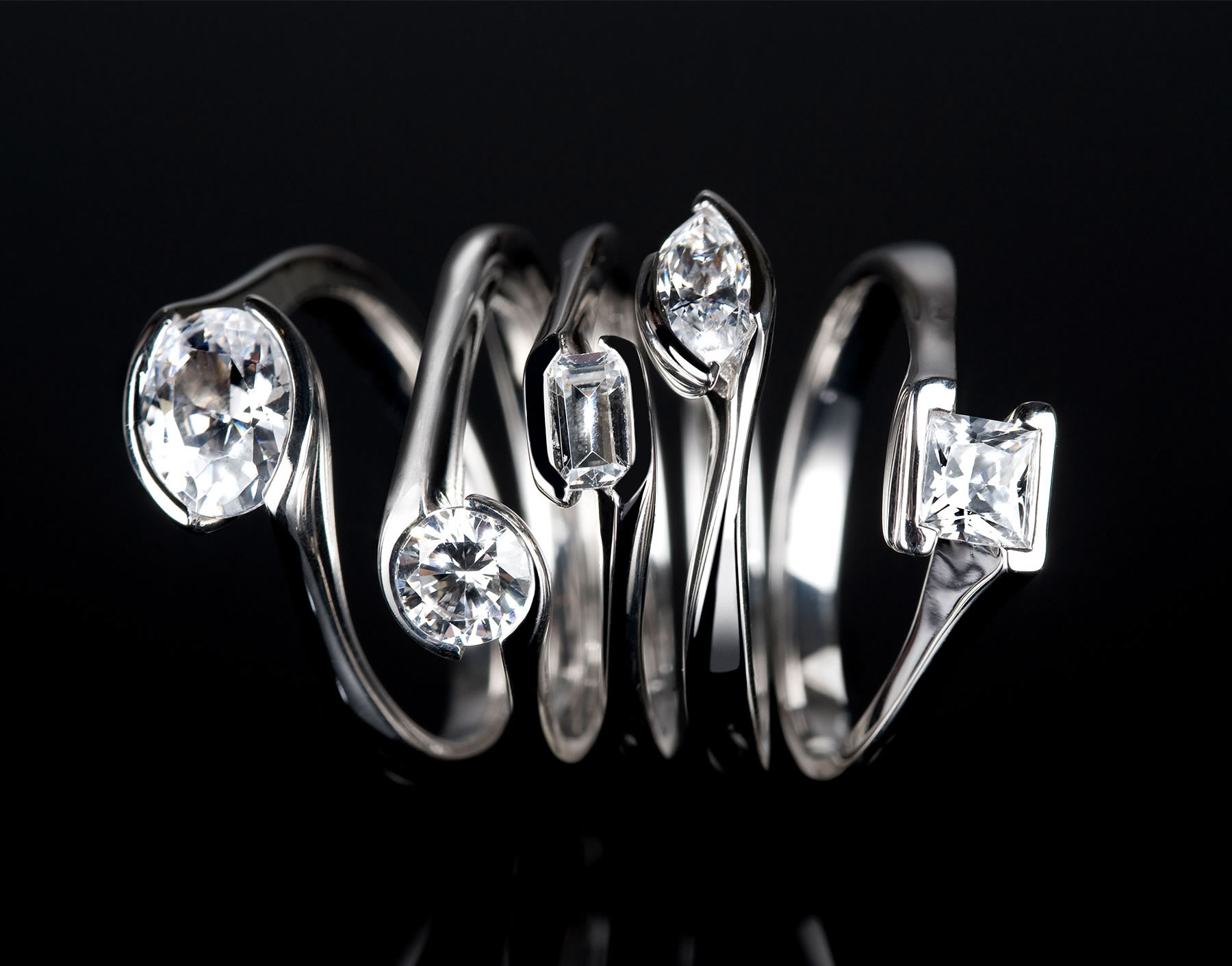
BLEMISHES This term is used to when the diamond has scratches or marks on the external area of the stone. BRILLIANCE Liveliness or sparkle in a stone when light is reflected from the surface and from the internal reflection of light. CARAT Refers to the measure of weight of a diamond. For more information, please visit our diamond education page. CARBON SPOTS Included crystals that have a dark appearance, rather than a white or transparent appearance when viewed under a microscope. In most cases, these dark inclusions are not visible to the naked eye, and do not affect the brilliance of the diamond. CLARITY A diamond often has natural imperfections, commonly referred to as "nature's fingerprints". Inclusions can be white, black, colourless or even red or green. Most inclusions are undetectable by the human eye and can only be seen with 10x magnification. Inclusions are ranked on a scale of perfection called 'clarity' ranging from IF (Internally Flawless) through to I (Included). For more information, please visit our diamond education page. CLOUDS A grouping of a number of extremely tiny inclusions that are too small to be distinguishable from one another, even under magnification. The result is that, under a microscope, this grouping often looks like a soft transparent cloud inside the diamond. Of course, clouds cannot be seen with the naked eye. Usually, this sort of inclusion does not significantly impace a diamond's clarity grade. COLOUR Diamonds are graded on a colour scale established some 70 years ago by the GIA (Gemmological Institute of America). The scale ranges from D (rare white) to Z (yellow). For more information, please visit our diamond education page. CULET Pronounced "Queue-lay", this is the bottom point of the diamond. Occasionally, the culet of the diamond is a surface instead of a point. CUT This refers to the angles and proportions a skilled craftsman creates in transforming a rough diamond into a polished diamond. Based on scientific formulae, a well cut diamond will internally reflect light from one mirror-like facet to another and disperse and reflect it through the top of the stone. This results in a display of fire and brilliance. For more information, please visit our diamond education page. DEPTH The height of a diamond from the culet to the table. The depth is measured in millimetres, or as a percentage of diameter. For more information, please visit our diamond education page. DIAMOND A diamond is the hardest known natural substance. It is crystallised carbon. Diamonds are mined in their rough form and then cut and polished to reveal their brilliance. Diamonds are worn by people as potent symbols - of love, devotion, pride, wealth and power. Diamonds, therefore, are the perfect gift for the perfect occasion. DIAMOND BRACELETS Diamond bracelets can be simple, yet stunning and elegant. Diamond tennis bracelets gained notoriety in recent years when Chris Evert famously dropped one of her diamond bracelets on centre court. Many other different styles are also available, making diamond bracelets an excellent choice for a birthday, anniversary or Christmas gift. DIAMOND CUTTING The method by which a rough diamond that has been mined from the earth is shaped into a finished, faceted stone. DIAMOND EARRINGS Diamond earrings make a wonderful gift for any occasion. Whilst many different styles are available ranging from trilogy and drop diamond earrings through to modern and contemporary styles, it is often the simple solitaire stud diamond earrings which provide the most stunning and dramatic impression. DIAMOND ENGAGEMENT RINGS Diamond engagement rings are the ultimate symbol of love. From classic solitaire diamond engagement rings to more elaborate trilogy and multi-stone diamond engagement rings, there is a wide range available. DIAMOND ETERNITY RINGS Diamond eternity rings reflect the love between 2 people. The selection of this important piece of diamond jewellery is more straightforward than other types of diamond jewellery as diamond eternity rings are typically either half or full set rings, and are either claw set or channel set. Diamond eternity rings most often use brilliant cut round diamonds although princess cut and baguette cut stones are also commonplace. DIAMOND JEWELLERY Over time, only a few diamonds survive their fantastic journey from their humble beginnings several billion years ago. Even fewer are discovered, and even fewer are suitable to be made into diamond jewellery. When producing diamond jewellery, modern designers often overlook the fact that the diamond is the most beautiful and important element of the design, not the metal. Diamond jewellery can range from simple diamond solitaire rings, through to elaborate diamond necklaces....all inspired by nature itself. DIAMOND NECKLACES Diamond necklaces are typically elaborate in design, and are the perfect compliment to that evening dress. Choosing just the style from the many diamond necklaces available nowadays provides the perfect opportunity to impress her. What better way of expressing your love than with a diamond necklace? DIAMOND PENDANTS Diamond pendants provide the ultimate accessory to any outfit. Ranging from the simple solitaire look to the more elaborate trilogy and drop diamond pendants, nothing catches the eye more than these fantastic pieces of diamond jewellery. Diamond pendants also make a perfect gift for birthdays, anniversaries and Christmas. DIAMOND RINGS The romantic tradition of giving diamond rings as tokens of love and commitment began in the 15th century when Archduke Maxmilian of Austria gave Mary of Burgundy a diamond ring on their engagement. Providing the ultimate symbol of love between 2 people, diamond engagement rings will forever be eternal. DISPERSION When light enters a diamond, it reflects off the facets and the angles cut into the stone. This distribution of light is known as dispersion, or the display of the spectral colours. ENGAGEMENT RINGS Engagement rings are traditionally given from man to woman, symbolising their commitment to each other. Diamonds, with their sheer beauty, provide the perfect gem to set into engagement rings. Whether it is single stone solitaire diamond engagement rings or multi-stone diamond engagement rings, there is an endless range of engagement rings to choose from. EYE-CLEAN A term used in the jewellery industry to describe a diamond with no blemishes or inclusions that are visible to the naked eye (ie a human eye which is not aided by magnifying devices such as a jeweller's loupe or a microscope). FACETS These are the tiny surfaces polished onto a rough diamond that gives a finished diamond its shape. The way the light interacts with these facets affects a diamond's brilliance and sparkle. For more information, please visit our diamond education page. FANCY SHAPES Any diamond shape other than round. For example, Princess cut diamonds (square), Emerald cut diamonds (rectangular), Marquise cut diamonds, Oval cut diamonds, Pear cut diamonds or Heart cut diamonds. For more information, please visit our diamond education page. FEATHER A feather is a type of inclusion of flaw within the diamond. FINISH The word finish is used to describe the exterior of the diamond. If a diamond is well polished, it has a very good finish. FIRE Often a term used instead of 'dispersion'. It is the variety and intensity of rainbow colours seen when light is reflected from a diamond. FLOURESCENCE When exposed to ultraviolet light, a diamond may exhibit a more white-ish, yellow-ish or blue-ish tint, which may imply that the diamond has a property called 'flourescence'. The untrained eye can rarely see the effects of fluorescence. Diamond grading reports state whether a diamond has fluorescent properties. Flourescence is not considered a grading factor, only a characteristic of that particular diamond. It is the effect of ultraviolet light on boron atoms that are found within certain diamonds. Interestingly, it is for this reason that UV light is used by diamond mining operations to aid in finding diamonds. For more information, please visit our diamond education page. GIRDLE The outer edge, or outline, of the diamond's shape. The girdle is not graded, but rather it is described by its appearance at its thinnest and thickest points. The descriptions of girdle thickness range as follows; extremely thin, thin, medium, slightly thick, thick, extremely thick. While it is less desirable for a round diamond to display an extremely thin or extremely thick girdle, such girdle widths are more common and acceptable in fancy shaped diamonds. For more information, please visit our diamond education page. INCLUSION A clarity characteristic found within a diamond. Most inclusions were created when the gem first formed in the earth. For more information, please visit our diamond education page. PAVE Pronounced "par-vay", this is a style of jewellery setting in which numerous small diamonds are mounted close together to create a glistening diamond crust that covers the whole piece of jewellery and obscures the metal under it. PAVILION Bottom portion of the stone, under the girdle, measuring to the culet. For more information, please visit our diamond education page. POLISH Indicates the care taken by the cutter in shaping and faceting the rough stone into a finished and polished diamond. PROPORTIONS The proportions of a diamond are very important, so that the maximum amount of light can be reflected off and out of a stone. Proportion is the relationship between the angles of the facets of the crown and pavilion. For more information, please visit our diamond education page. SYMMETRY A diamond's symmetry is the arrangement of the facets and finished angles, created by the diamond cutter. Excellent symmetry of a well cut and well proportioned diamond can have a great effect on the diamond's brilliance and fire. For more information, please visit our diamond education page. TABLE FACET This is the largest facet of a diamond. It is located on top of the stone. For more information, please visit our diamond education page. TABLE SPREAD Term used to describe the width of the table facet, often expressed as a percentage of the total width of the stone. For more information, please visit our diamond education page.
|
CALL
0845 355 1164 OR EMAIL info@dejoria.co.uk
|
|||||||||||||||||||||||||||||||
Privacy Policy | Terms & Conditions | Links | Site Map | XML © DeJoria.co.uk Site Version 3.1.3.6|1.2.1.8 |
|