DeJoria Diamonds birthstone promotion banner
Education
Quick search:
Shop by Product
Create Your Diamond RingCreate Your Diamond Ring
Diamond Jewellery CollectionDiamond Jewellery Collection
Wedding BandsWedding Bands
Customer Information
Home
OUR COMPANY
About UsOur CredentialsWhy Buy From Us?How To Use Our SiteLatest News
RESEARCH & EDUCATION
Tips For Buying OnlineHistory of DiamondsEducationDiamond CertificationJewellery ValuationsGemstonesChoosing Your Diamond RingConflict Free DiamondsPrecious MetalsPrice ComparisonsRing Size HelpEngraving ServiceRequest a SampleHow Do We 'Create Your Diamond Ring'Caring For Your Diamond RingProposal IdeasWedding PlanningGlossaryFrequently Asked Questions
PAYMENT & DELIVERY
PaymentDeJoria FinanceJewellery InsurancePackagingDeliveryPromotionsMoney Back GuaranteeLifetime Care ProgrammeLoyalty Bonus SchemeReturns PolicyOrder Tracking
WHAT THEY SAY ABOUT US
TestimonialsRefer A FriendDeJoria In The PressCustomer Satisfaction Survey Results
Contact Us
Special Offers Special Offers
Search By Price Search By Price
Newsletter Sign-up Newsletter Sign-up
Add to Favourites Add to Favourites
 

Education

As part of your diamond jewellery buying experience, it is important to understand how a diamond is graded in terms of its characteristics. An estate agent, for example, can't determine the price of a house without knowing its size, condition, location etc. This is also true for a diamond.

Fortunately, there is an internationally recognised system for diamond grading - called the "4Cs".

These are: Furthermore, at DeJoria, we believe it is extremely important to consider 3 additional factors: Of the 'traditional' 4Cs, no one 'C' is more important than another in terms of beauty, and it is important to note that each of the 4Cs will not diminish in value over time unless damaged by an accident. Remember that buying a diamond is an investment, since it maintains its qualities and value forever.

Before embarking on the diamond education process, you might find it useful to visit our Glossary of Terms.

CUT
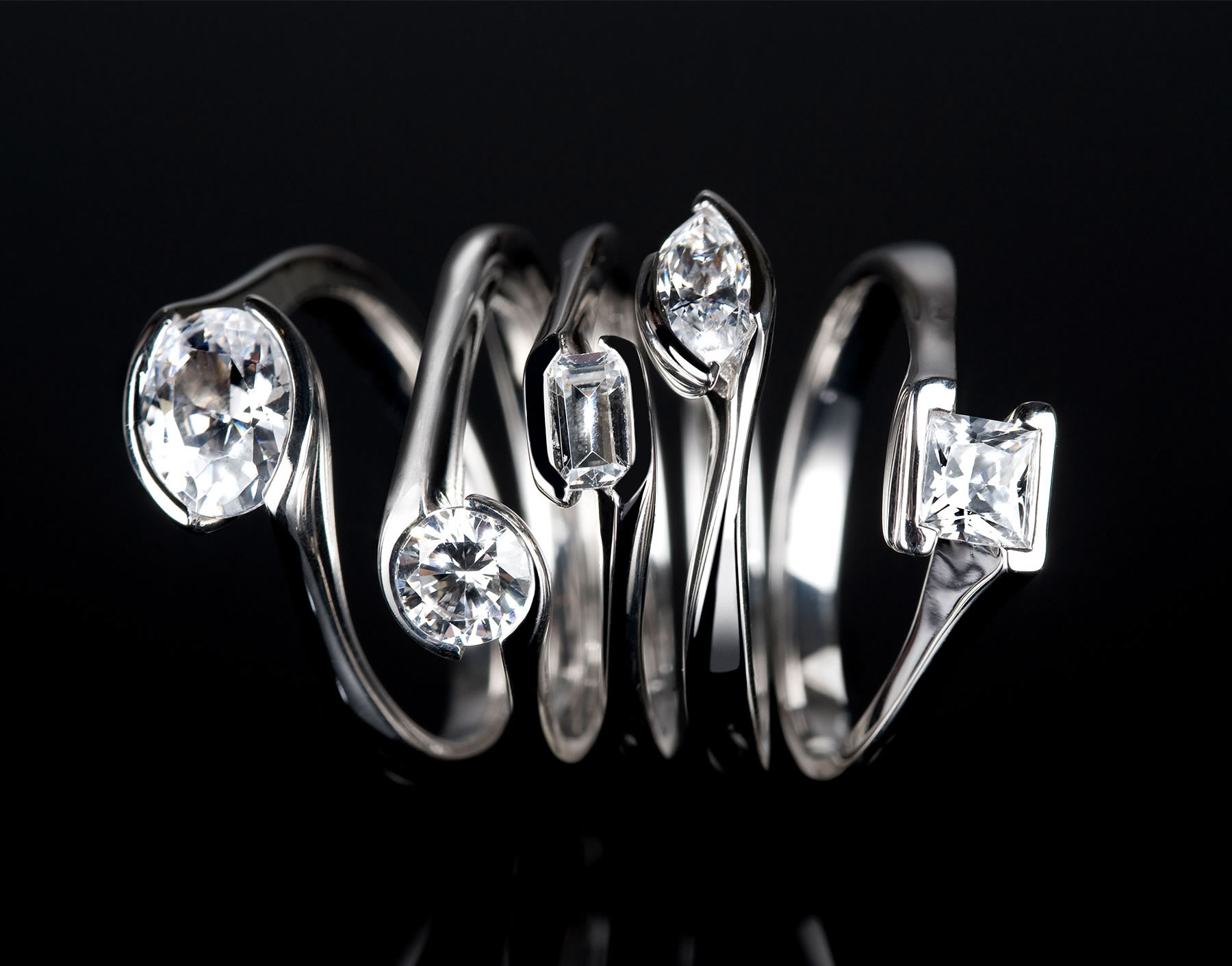
The cut of the shape is most commonly referred to as the shape of the diamond itself. Most people think of a diamond as being round in shape - therefore, the brilliant round cut diamond is the most popular. However, 'fancy shaped' diamonds (ie all diamond shapes which are not round) have grown in popularity over the years such as princess cut diamonds (square), emerald cut diamonds (rectangular), marquise cut diamonds, oval cut diamonds and pear cut diamonds amongst others.

Brilliant cut round diamonds Brilliant Round Cut Diamonds - The brilliant round cut diamond is the most traditional and popular of all the diamond shapes. It has 58 facets and is cut to maximise the 'fire' and sparkle of the stone. This shape of diamond is most commonly found in solitaire diamond engagement rings.
Princess cut diamonds Princess Cut Diamonds - The princess cut diamond shape has grown in popularity in recent years, providing an excellent alternative to the brilliant round cut diamond and, by having 76 facets, often displaying even more brilliance than its round counterpart. Most commonly found in solitaire diamond engagement rings.
Emerald cut diamonds Emerald Cut Diamonds - The emerald cut diamond is 'step-cut' and has rows of facets, usually 48 to 50, that resemble a staircase. The look of an emerald cut diamond is subtle and understated, with less ‘fire’ than a brilliant round cut diamond, but provides style and elegance. Most commonly found in diamond trilogy rings and more contemporary diamond rings.
Marquise cut diamonds Marquise Cut Diamonds - This takes its name from a legend that the Sun King desired a stone to be polished into the shape of the mouth of the Marquise of Pompadour. It has a total of 56 facets. Ideal for solitaire diamond engagement rings and diamond pendants.
Oval cut diamonds Oval Cut Diamonds - The oval cut diamond provides an excellent alternative to the brilliant round cut diamond, whilst displaying the same amount of brilliance through its 56 facets. Ideal for solitaire diamond engagement rings and diamond pendants.
Pear cut diamonds Pear Cut Diamonds - The pear cut diamond is another alternative to the brilliant round cut diamond and contains a total of 58 facets. Ideal for solitaire diamond engagement rings and diamond pendants.
Radiant cut diamonds Radiant Cut Diamonds - The radiant cut diamond is a straight-edged rectangular or square stone with cut corners. With a total of between 62-70 facets, the radiant cut diamond can offer an excellent compromise between the rectangular shape of the emerald cut diamond and the square shape of a princess cut diamond, whilst having all the sparkle of a princess cut diamond. Most commonly found in diamond engagement rings, with shoulder diamonds.
Heart cut diamonds Heart Cut Diamonds - The heart cut diamond represents the ultimate symbol of romance and is essentially a pear-shaped diamond with a cleft at the top. Ideal for diamond pendants.

The cut can also relate to the proportions of the diamond - in other words, the symmetry of the diamond and the quality of the finish. This refers to the relationship between the various parts of the stone - for example, the width in Diamond symmetry diagramrelation to the depth of the diamond and the percentage of surface the table (the flat facet on the top part of the stone) has in relation to the width of the diamond. If these relationships are not optimal, the fire and brilliance of the diamond are affected, and undesirable visual effects may occur. It is, therefore, the nature and extent of these effects that combine to give the diamond its final grade.

We ONLY deal in diamonds with 'Good', 'Very Good' or 'Excellent' proportions. We will NEVER deal in diamonds with 'Fair' proportions, as this simply detracts from the brilliance or 'sparkle' of the diamond. The diamond's measurements and proportions are always outlined on its accompanying grading certificate. Click here for more information.

Diamond cut diagram
Diamond anatomy diagram
There is a well known 'ideology' for the depth and table for brilliant round cut diamonds (Depth 58-63% and Table 53-60%), but guidelines also exist for fancy shaped diamonds, all of which are outlined below for your reference:


Princess Cut diamonds proportions
Emerald Cut diamond proportions
Marquise Cut diamond proportions
Oval Cut diamond proportions
Pear Cut diamond proportions
Radiant Cut diamond proportions

CARAT SIZE
The word "carat" is taken from the carob seeds that people once used in ancient times to balance scales. This was standardised in 1907 - one carat became 0.2 grams. Furthermore, once carat is divided into 100 "points". Therefore, 25 points is ¼ carat, 50 points is ½ carat and so on.

Diamonds are rare. The larger the diamond, the rarer it is - larger diamonds, therefore, have a greater value per carat. For that reason, the price of a diamond rises exponentially with its size. This is not always to say, however, that the larger the diamond the more valuable it is compared with a smaller stone. This is dependent upon other characteristics as well.

The following table shows key carat weights relate to size in millimetres for various shaped diamonds.

Approximate stone sizes in millimetres

Carat
Weight
Brilliant
Round
Princess Emerald Marquise Oval Pear Heart
0.25ct 4.2 3.3sq L4 x W3 L5 x W3 L5 x W3 L4.5 x W2.5 3.9
0.30ct 4.4 3.5sq L4.5 x W3 L6 x W3 L5 x W3.25 L5 x W3 4.0
0.33ct 4.5 3.7sq L5 x W3 L6.5 x W3.5 L5 x W2.75 L5.25 x W3.25 4.5
0.40ct 4.8 3.9sq L5 x W4 L7 x W4 L5 x W4 L5.5 x W3.5 4.75
0.45ct 5.0 4.0sq L5.5 x W4 L7.5 x W4 L5.25 x W4.25 L5.75 x W3.75 4.8
0.50ct 5.2 4.2sq L6 x W3 L8 x W4 L5.5 x W4.5 L6 x W4 4.8
0.55ct 5.4 4.4sq L6 x W3.5 L8 x W4.5 L5.75 x W4.5 L6.25 x W4.25 4.95
0.60ct 5.5 4.5sq L6 x W4 L8.25 x W5.5 L6.25 x W4.5 L6.4 x W4.4 5.1
0.65ct 5.7 4.6sq L6.25 x W4 L8.5 x W6.5 L6.5 x W4.5 L6.6 x W6.6 5.25
0.70ct 5.8 4.75sq L6.25 x W4.25 L9 x W4 L6.75 x W4.75 L6.8 x W6.8 5.4
0.75ct 5.9 4.8sq L6.5 x W4.5 L9 x W4.5 L7 x W5 L7 x W5 5.6
0.80ct 6.1 4.85sq L6.75 x W4.5 L9 x W5 L7.1 x W5.1 L7.2 x W5 5.8
0.85ct 6.2 4.9sq L6.75 x W4.75 L9.25 x W5 L7.2 x W5.2 L7.4 x W5 5.9
0.90ct 6.3 5.0sq L6.85 x W4.85 L9.5 x W5 L7.3 x W5.3 L7.6 x W5 5.95
0.95ct 6.4 5.1sq L7 x W4.85 L9.75 x W5 L7.4 x W5.4 L7.8 x W5 6.0
1.00ct 6.5 5.25sq L7 x W5 L10 x W5 L7.5 x W5.5 L8 x W5 6.0
1.25ct 7.0 5.9sq L7.5 x W5.5 L10.5 x W5 L8 x W6 L8.5 x W5.5 6.5
1.50ct 7.5 6.0sq L8 x W6 L11 x W5 L8.5 x W6.5 L9 x W6 6.9
1.75ct 7.9 6.25sq L8.25 x W6.25 L11 x W5.5 L9 x W6 L9.5 x W6.5 7.3
2.00ct 8.2 6.5sq L8.5 x W6.5 L12 x W6 L9 x W7 L10 x W7 7.5
2.25ct 8.5 7.0sq L8.75 x W6.75 L12.5 x W6 L9.25 x W7.25 L11 x W7 7.9
2.50ct 8.9 7.5sq L9 x W7 L13 x W5.5 L9.5 x W7.5 L12 x W7 8.4
2.75ct 9.0 8.0sq L9.5 x W7.5 L13 x W6 L9.75 x W7.75 L12.25 x W7.5 8.6
3.00ct 9.4 8.25sq L10 x W8 L14 x W7 L10 x W8 L12.5 x W7.75 8.9
3.25ct 9.6 8.5sq L10.25 x W8.25 L14.5 x W7 L10 x W8.25 L12.75 x W8 9.1
3.50ct 9.9 8.75sq L10.5 x W8.5 L15 x W7 L10 x W8.5 L13 x W8.25 9.4
3.75ct 10.1 9.0sq L10.75 x W8.75 L15.5 x W8 L10.5 x W8.75 L13.25 x W8.75 9.6
4.00ct 10.4 9.25sq L11 x W9 L15.5 x W8.5 L11 x W9 L13.25 x W9 9.9


COLOUR
The most valuable diamonds are colourless. They allow most light to pass through the stone and create the most brilliance. However, very few diamonds are colourless, so most diamonds will have some yellow in them - the less yellow the better. The colour scale goes from D to Z (no diamond of colour A, B or C has ever been found), with D being the most white and Z being the most yellow. At DeJoria, our minimum quality threshold is colour J (slightly tinted yellow). For comparison purposes, the majority of diamonds in a high street jewellers shop are 'Commercial grade' quality which, if graded on this scale, would be approx colour K / L.

Diamond Colour


D - Exceptionally white
E - Exceptionally white
F - Rare White
G - White
H - White
I - Slightly tinted white
J - Slightly tinted white
Any diamonds with a colour grade of less than J would fall below DeJoria's quality threshold.


CLARITY

The clearer the diamond, the greater its brilliance, and the greater its value. Most diamonds have blemishes, called 'inclusions' which are nature's birthmark of the stone. These can be tiny traces of carbon (black spots), air pockets (white spots) or other naturally occurring phenomena. Diamond clarity ranges from diamonds without any flaws (internally flawless) to those that have visible inclusions. At DeJoria, our minimum quality threshold is SI2 ("Slightly Included" - not visible with the naked eye). For comparison purposes, the majority of diamonds in a high street jewellers are 'Commercial grade' quality which, if graded on this scale, would be approx clarity I1 / I2.

Diamond Clarity


IF - Flawless, or Internally Flawless
VVS1 - Very, Very Slightly Included. Requires 60x magnification to see any inclusions
VVS2 - Very, Very Slightly Included. Requires 60x magnification to see any inclusions
VS1 - Very Slightly Included. Requires 30x magnification to see any inclusions
VS2 - Very Slightly Included. Requires 30x magnification to see any inclusions
SI1 - Slightly Included. Generally requires 10x magnification to see any inclusions.
SI2 - Slightly Included. Generally requires 10x magnification to see any inclusions
Any diamonds with a clarity grade of less than SI2 would fall below DeJoria's quality threshold.


CERTIFICATION
Whilst the acquisition of a diamond engagement ring or other piece of diamond jewellery is an important expression of love or accomplishment, it also represents a major investment in time, energy and money. You need and deserve to feel confident in the integrity of what you've acquired. There is no typical industry standard for diamond certification in the UK - and therefore, you'll find that the majority of diamond jewellery in a high street jewellers will be non-certified. At DeJoria, we believe it is vital that you buy certified diamonds for your peace of mind. At DeJoria, we use GIA, IGI, AGS and HRD certified diamonds. Click here for more information.


CONFLICT-FREE
Conflict Free diamonds logoToday, an illegal trade exists within the diamond industry whereby the profits generated by the mining of diamonds - predominantly in 3rd world countries - have been used to fund wars and terrorist activity. These are known as "conflict diamonds" or "blood diamonds". The Kimberley Process was established in 2000 between governments across the world in an attempt to eradicate this disgraceful activity, and DeJoria wholeheartedly supports this initiative for we believe that wherever you purchase your diamond engagement rings, diamond eternity rings, diamond rings and diamond jewellery, the diamonds should ALWAYS be conflict-free, and not tarnished by a dark history. For more information, click here.


CONFIDENCE

INDEPENDENT INSURANCE VALUATIONS
DeJoria also provides an independent insurance valuation dossier on all 'Create Your Diamond Ring' items and higher valued items in our 'Diamond Jewellery Collection', where the item is appraised and examined by an independent gemologist. This dossier serves 2 Safeguard Insurance Valuation Dossiersimportant purposes - Firstly, it provides our clients with complete piece of mind that the diamond jewellery they have purchased is indeed the genuine article. Secondly, loss or damage of a personal item is always distressing, but think how much worse it would be if you have no idea of the worth of the item you have lost and have no way of convincing your insurer of its value. Safeguard take digital photographs of the diamond jewellery, note any distinguishing features, take a full and accurate description and place a value upon the item for insurance purposes. All this information is permanently stored onto a national computer database providing our clients, the police and your insurer with conclusive proof of ownership.

Safeguard Quality Assurance Insurance Limited is located within the UK Assay Office - the UK's leading gemmological authority. It was founded by Act of Parliament in 1773 and its prime function is to carry out independent testing and hallmarking.

Click here to visit the website for Safeguard Quality Assurance Limited.


Diamond jewellery portfolioSingle purchases in excess of £10,000 will be accompanied by a 'Jewellery Portfolio' as part of our package. This provides a comprehensive description and valuation of the diamond jewellery, high quality images of the item, and helpful information to explain diamond grading, hallmarking and jewellery care. All this is provided in a luxury leather presentation wallet.


HALLMARKING
It is consumer law in the UK that all precious metal jewellery carry a hallmark. This is a tiny stamp on the inside of the ring mount which is your assurance that the platinum or gold in your diamond engagement ring, diamond eternity ring or diamond jewellery is indeed that. Hallmarking in this country is carried out by the UK Assay Office. We only use the best quality 950 platinum, or 18kt white / yellow gold for our jewellery. Visit our precious metals page for more information.

BRITISH JEWELLERS' ASSOCIATION
British Jewellers' Association logoThe British Jewellers’ Association is the national trade association which promotes and protects the growth and prosperity of UK jewellery companies. We adhere and support the BJA's Code of Ethics, which are outlined on the our credentials page.

If you would like to personally discuss your specific requirements with one of our in-house diamond experts, please do not hesitate to contact our customer service helpline on 0845 355 1164 or email info@dejoria.co.uk.
Telephone 0845 355 1164
Email info@dejoria.co.uk
Or click here to visit our list of Frequently Asked Questions
CALL
0845 355 1164
OR EMAIL
info@dejoria.co.uk
Your Basket
Empty
Your Account
Your E-mail:

Password:

Why Buy from Us?
DIAMOND RING OF THE WEEK
Featuring one of our stunning designs each week
Read More
Diamond Ring Of The Week
DESIGN WITH DEJORIA
Work with us to produce your unique design
Read More
Design with DeJoria
The Good Web Guide

SafeBuy

The British Jewellers' AssociationThe Assay Office

Stop Blood Diamonds

Platinum Guild International


Barclay Card Delta Eurocard / Mastercard Maestro Visa Electron Visa American Express

Privacy Policy | Terms & Conditions | Links | Site Map | XML
© DeJoria.co.uk Site Version 3.1.3.6|1.2.1.8

Valid HTML 4.0